


I went into 2025 incredibly amped to review ASUS’s 2.2-pound ZenBook A14, only to be disappointed by the lackluster performance of its Snapdragon X chip. I’m still a bit heartbroken, to be honest. But now ASUS is back with a revamped A14 and a larger 16-inch ZenBook A16, both of which sport new Snapdragon X2 Elite Extreme chips. The A16 is slightly heavier at 2.6 pounds and 2.9 pounds, but it still competes with LG’s Gram Pro 16. And thanks to Qualcomm’s new hardware, it’s actually speedy enough to compete with Intel and AMD ultraportables.
Take everything I initially liked about the ZenBook A14 last year — its thin design and portability, its smooth “Ceraluminum” case and its bold OLED screen — stretch it out a bit, and you’ve got the ZenBook A16. There’s an understated beauty to its design that’s far more intriguing than ASUS’s mainstream notebooks, like the ZenBook 14 OLED from a few years ago, and it’s not trying as hard to impress as ASUS’s typical gaming notebooks. It’s similar to the company’s gorgeous Zephyrus G14 and G16 machines, which feel high-end without needing too much gaming bling.
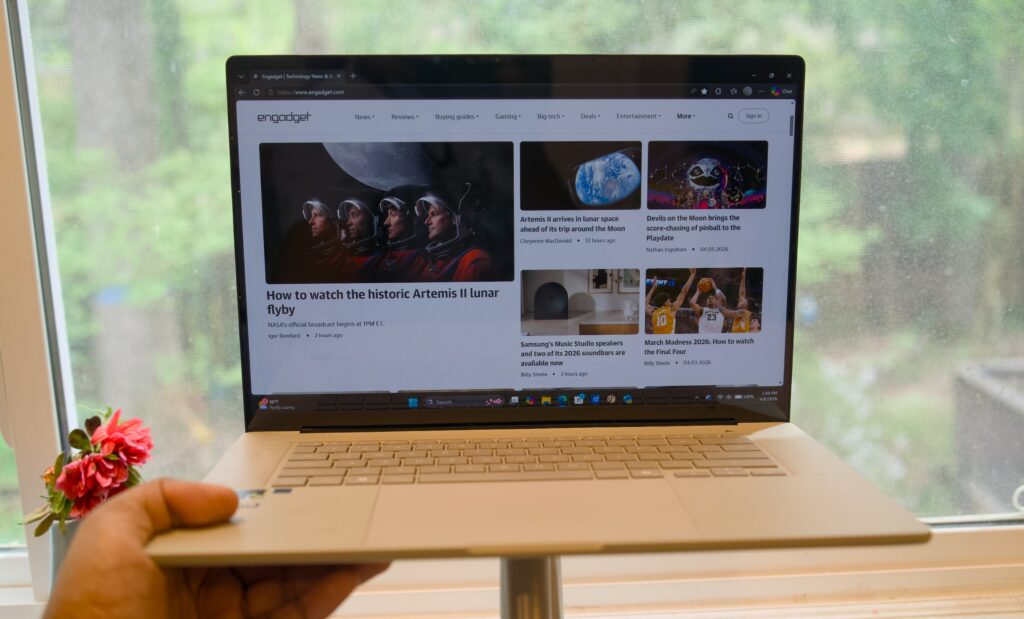
What struck me first about the A14 last year remains the most intriguing aspect of the A16: It just seems impossibly light for its size. The model I’m testing, which will also be sold at Best Buy, weighs 2.9 pounds due to its glass touchscreen cover. But you can also get a slimmer 2.6-pound version of the A16 at ASUS’s online store.
ASUS’s Ceraluminum material, which feels like a blend of ceramic and metal, also exudes quality and warmth when you hold it. There’s no shock of cold metal on your lap like you’ll find with most premium laptops, including Apple’s MacBook Pro. But it’s also just as sturdy as those machines, with no discernible creaks or flex when stressed. ASUS claims its Ceraluminum cases are also scratch and fingerprint resistant, and so far that seems to be true of my review unit after a few weeks of testing.
ASUS Zenbook A16
Devindra Hardawar for Engadget
The ZenBook A16’s stunning 16-inch 3K OLED screen is its defining feature, and it delivers everything you’d expect from OLED. Colors look bold and bright, and it offers inky dark black levels. It delivers an eye-popping sense of contrast you won’t find on most LCD screens (unless they have Mini LED backlights, like the MacBook Pro). Text appears crisp and sharp, and the large screen size does a great job of making video playback feel immersive (especially if you’re laying in bed, trying to catch up on The Pitt).
Personally, I’d still opt for the A14 because of the weight difference, but if you prefer big screens this is certainly one of the most intriguing options around. The A16 also has a full-sized SD card reader and HDMI connection, both of which the smaller model lacks entirely. ASUS also included a healthy amount of other ports, including two USB-C 4.0 connections, one USB Type A 3.2 port and a headphone jack. From a productivity perspective, yo