
Connect with us

HealthNews

Demoralized CDC Workforce Reels From Year of Firings, Funding Cuts, and a Shooting
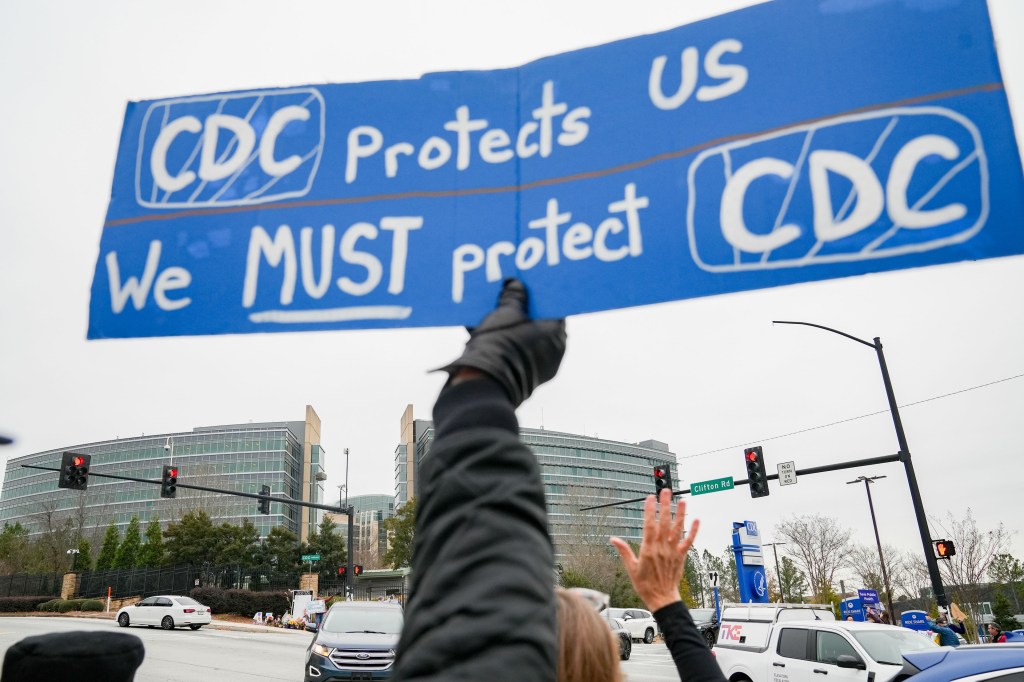
​On the coffee table at her home in Atlanta, Sarah Boim has a pile of documents from her old job at the Centers for Disease Control and Prevention. They are printouts of her employment records.

Boim lost her job in the first big wave of CDC firings — more than 1,000 people were suddenly let go last February.

“This is the termination letter. I also printed off my performance review from 2024,” she said. “I knew I wouldn’t have access to it, and everything was so chaotic that I needed proof of what was happening.”

Boim worked in the National Center for Environmental Health/Agency for Toxic Substances and Disease Registry, handling communications about radon, substances known as forever chemicals, lead poisoning, and other health threats.

Rereading her termination letter, she still can’t believe what it says.

“The agency finds you are not fit for continued employment because your ability, knowledge, and skills do not fit the agency’s current needs, and your performance has not been adequate to justify further employment at the agency,” the emailed letter reads.

“And that floored me,” Boim said, “because my performance was rated outstanding, and I even got a raise. It was just deeply insulting. So I was more upset than I think I was prepared to be.”

The Trump administration later brought back some of the workers who were fired in the first round, but it has also cut more staff and funding.

The CDC has been without a permanent director for more than six months. Recently the Trump administration made Jay Bhattacharya the CDC’s interim director, while he also runs the National Institutes of Health.

The leadership uncertainty comes amid a year of disruption and dismissals at the Atlanta-based institution, from which more than 3,000 public health workers are now gone. That includes staffers the Trump administration terminated and workers who accepted early retirement.

Ripple effects of the turmoil are still hitting the Atlanta region.

By the end of 2025, the CDC had lost roughly a quarter of its workforce.

Boim now works as a contractor in the health field, while also working a non-health-related freelance job. But she mourns the cuts at the CDC, and how the loss of expertise and resources will trickle down to communities. A significant portion of CDC funding goes directly to states and local public health departments.

“It will cause generational harm, which always makes me tear up,” Boim said. “The harm that’s going to come to people that don’t even know what CDC was protecting them from.”

“But for Atlanta, there’s a lot of us; there are thousands of CDC employees that live here,” she added. “We are your friends, your neighbors, your family, and — with the lost income — it has an impact on local businesses also.”

At the SriThai restaurant across the street from the main CDC campus, more than a third of the customers are CDC employees, said manage  

Continue Reading
Click to comment

Leave a Reply

Your email address will not be published. Required fields are marked *

HealthNews

¿Qué tan bajo se puede llegar? Las cambiantes guías para el control de la presión arterial

​La paciente fue por primera vez a ver a Mark Supiano en 2017 porque su familia estaba preocupada:  estaba perdiendo la memoria a corto plazo.

Mientras revisaba su historial y signos vitales, Supiano, geriatra en la Universidad de Utah, observó una señal preocupante: su presión arterial era de 148/86, por encima de lo normal a pesar de que tomaba dos medicamentos para bajarla. “Claramente era demasiado alta”, dijo recientemente.

Varios factores podrían haber contribuido a ese número, incluidos el medicamento antiinflamatorio que la mujer de 78 años tomaba para el dolor de artritis, una dieta alta en sodio y la falta de ejercicio regular. También le dijo a Supiano que solía beber un par de copas de vino cada noche.

Después de que Supiano hablara con ella sobre formas de reducir su riesgo, la mujer y su esposo se inscribieron en un gimnasio. Dejó el antiinflamatorio y redujo la sal y el alcohol, lo que llevó su presión sistólica a un rango de 130 a 140 —todavía hipertensión, según las guías publicadas por la Asociación Americana del Corazón (AHA) y el Colegio Americano de Cardiología (ACC) a finales de ese año, pero más aceptable. (La sistólica es el número superior en la medición de la presión arterial y el más importante desde el punto de vista clínico).

Sin embargo, para 2019, la paciente tenía un diagnóstico de deterioro cognitivo leve y comenzaban a surgir evidencias médicas sobre la relación entre la hipertensión (el término médico para presión arterial alta) y la demencia. “No fui tan agresivo como debí haber sido”, recordó Supiano. Agregó un tercer medicamento para la hipertensión y sus cifras bajaron a 120 o menos.

Las guías cambiantes para el control de la presión arterial pueden recordar a las personas de mayor edad un baile de moda en su juventud: el limbo. Como decía Chubby Checker: “¿Qué tan bajo puedes llegar?”

Durante más de 25 años, una lectura de 140/90 o menos se consideró normal, según las guías de la AHA/ACC. Pero la actualización de 2017 introdujo cambios importantes, respaldados por los resultados del ensayo SPRINT, que incluyó a adultos mayores de 50 años con alto riesgo cardiovascular.

El ensayo SPRINT encontró que un tratamiento intensivo dirigido a reducir la presión sistólica por debajo de 120 disminuía el riesgo de ataques cardíacos, accidentes cerebrovasculares, otras enfermedades cardiovasculares y la mortalidad general de manera tan significativa que los investigadores detuvieron el estudio antes de tiempo para ofrecer recomendaciones.

Consideraron que no era ético negar a la mitad de los participantes los beneficios del tratamiento intensivo. Por eso, las guías de 2017 recomendaron medicación para quienes tenían una presión sistólica superior a 130.

Las revisiones más recientes, publicadas a finales del año pasado, promueven un control aún más estricto. Recomiendan que los pacientes con ries  

Continue Reading

HealthNews

Journalists Shine Light on Out-of-Reach Insurance Prices, AI’s Role in Claims Disputes, and Susie Wiles

Latest haryana news 247

​KFF Health News senior correspondent Renuka Rayasam discussed the KFF Health News series “Priced Out,” which focuses on the health insurance crisis, on An Arm and a Leg on March 19.

Click here to hear Rayasam on An Arm and a Leg (starts at 21:03).

Read Rayasam’s “When Health Insurance Costs More Than the Mortgage.”

KFF Health News rural health reporter Andrew Jones discussed the spread of measles across the Carolinas on WUNC’s Due South on March 17.

Click here to hear Andrew Jones on Due South.

Read Jones’ “Hospitals Fighting Measles Confront a Challenge: Few Doctors Have Seen It Before.”

Céline Gounder, KFF Health News’ editor-at-large for public health, discussed on CBS News 24/7’s The Daily Report on March 16 how U.S. hospitals and insurers are turning to AI to settle disputes over medical claims and payments. On March 17, she outlined the court ruling blocking the Trump administration’s vaccine policy changes for children on CBS News’ CBS Mornings. Gounder also discussed Susie Wiles’ decision to stay on as White House chief of staff amid breast cancer treatment on CBS News 24/7’s The Takeout on March 16.

Click here to watch Gounder discuss hospitals, insurers, and AI on The Daily Report.

Click here to watch Gounder discuss vaccine policy changes for children on CBS Mornings.

Click here to watch Gounder discuss White House chief of staff Susie Wiles on CBS Mornings.

KFF Health News is a national newsroom that produces in-depth journalism about health issues and is one of the core operating programs at KFF—an independent source of health policy research, polling, and journalism. Learn more about KFF.USE OUR CONTENTThis story can be republished for free (details).  

Continue Reading

HealthNews

What the Health? From KFF Health News: RFK Jr.’s Vaccine Schedule Changes Blocked — For Now
​The Host

Julie Rovner
KFF Health News

@jrovner

@julierovner.bsky.social

Read Julie’s stories.

Julie Rovner is chief Washington correspondent and host of KFF Health News’ weekly health policy news podcast, “What the Health?” A noted expert on health policy issues, Julie is the author of the critically praised reference book “Health Care Politics and Policy A to Z,” now in its third edition.

Health and Human Services Secretary Robert F. Kennedy Jr.’s effort to change how the federal government recommends vaccines against childhood diseases was dealt at least a temporary setback in federal court this week. A judge in Massachusetts sided with a coalition of public health groups arguing that changes to the vaccine schedule violated federal law. The Trump administration said it would appeal the judge’s ruling.

Meanwhile, some of the same public health groups continue to worry about the slow pace of grantmaking at the National Institutes of Health, which, for the second straight year, is having trouble getting money appropriated by Congress out the door to researchers.

This week’s panelists are Julie Rovner of KFF Health News, Alice Miranda Ollstein of Politico, Margot Sanger-Katz of The New York Times, and Lauren Weber of The Washington Post.

Panelists

Alice Miranda Ollstein
Politico

@AliceOllstein

@alicemiranda.bsky.social

Read Alice’s stories.

Margot Sanger-Katz
The New York Times

@sangerkatz

Read Margot’s stories.

Lauren Weber
The Washington Post

@LaurenWeberHP

Read Lauren’s stories.

Among the takeaways from this week’s episode:

The latest decision on potential changes to the federal childhood vaccine schedule, even if ultimately reversed by a higher court, may re-elevate the vaccine issue as midterm campaigns kick into gear — and just as the Trump administration is trying to downplay it.

A new survey of Affordable Care Act marketplace enrollees from KFF, a health information nonprofit that includes KFF Health News, illuminates how many people are struggling to afford health insurance after the expiration of the enhanced premium tax credits. A large majority of respondents say their costs are higher this year, with half saying their costs are “a lot higher.”

A dip in the number of health care jobs last month could suggest medical facilities and other providers are bracing for the impact of federal funding cuts. A reduction in the number of people with health insurance — an expected outcome of the expiration of enhanced ACA tax credits and, soon, stricter eligibility limits for Medicaid — would probably mean more unpaid bills that hospitals and others must abs  

Continue Reading

HealthNews

Birth Control Skepticism, Teen Fertility Education Center Stage at Trump’s Women’s Health Summit

​WASHINGTON — Surrounded by hot pink lights and cherry blossom pink drapes on a ballroom stage, family doctor Marguerite Duane offered a seemingly simple solution to infertility: Doctors should have conversations with young girls about whether they want to have children one day.

“I have these conversations with children starting at 8, 10, 12 years old: What do you want to be when you grow up?” Duane said. If you’re a child who wants to be a doctor, for instance, “there are things you need to put in place. If you hope to have children one day, there are things that you need to consider and have the conversation early.”

The proposal from Duane, a specialist in restorative reproductive medicine who is affiliated with the anti-abortion Charlotte Lozier Institute, got a warm reception from the audience gathered for the Trump administration’s inaugural National Conference on Women’s Health.

The three-day event hosted by the Department of Health and Human Services last week was designed to “explore breakthroughs in research, prevention, diagnosis, and treatment of health conditions that affect women across the lifespan.” Government officials hosted an eclectic mix of wealthy philanthropists, alternative medicine influencers, health tech executives, and medical researchers to discuss a wide range of issues, from Lyme disease to gut health.

Seeking to reach women at a moment when President Donald Trump’s support is slipping among a key voting bloc, the Make America Healthy Again movement, the administration-sponsored event elevated perspectives outside conventional standards of medical care and counter to many women’s health choices.

For example, during a 40-minute panel hosted by Alexis Joel, the wife of musician Billy Joel, several doctors raised concerns about how frequently hormonal birth control is used to treat women’s health symptoms. Duane and the two other female physicians on the panel said they were uncomfortable with the idea of using birth control pills for their own treatment, noting that their “values” or “cultural perspective” did not align with use of the medication.

Nearly a third of U.S. women ages 18 to 49 report having used birth control pills in the previous 12 months, according to a 2024 KFF survey. In addition to their use as a contraceptive, the pills are prescribed for a variety of health issues, including preventing anemia from heavy periods and treating uterine fibroids.

Joel, who has spoken publicly about her experience with endometriosis, brought her own doctor, Tamer Seckin, to discuss the common, painful condition, in which thick tissue develops outside of the uterus. Seckin said women’s concerns about menstrual pain are often dismissed by doctors, leading to missed diagnoses.

Asima Ahmad, a doctor who specializes in fertility and co-founded Carrot, a company that offers job-based fertility benefits, offered another explanation for why the disease is ove  

Continue Reading

HealthNews

Doctores alertan sobre una complicación mortal asociada a los brotes de sarampión

​La primera señal apareció cuando Deepanwita Dasgupta tenía 5 años y empezó a tropezar más a menudo mientras jugaba en su casa en Bangalore, en el sur de India. La niña siempre estaba haciendo algo; por eso sus padres pensaron que los golpes y moretones extra eran simplemente parte de una infancia activa.

Quizás, pensaron, se trataba de unos zapatos que no le quedaban bien.

Los familiares describían a la niña amante de los unicornios como inteligente, cariñosa y a veces un poco traviesa. Antes de aprender el alfabeto, ya había descubierto cómo encontrar su programa favorito, Blippi, en un teléfono. También era conocida por sacar mantequilla del refrigerador a escondidas para disfrutarla lamiéndose los dedos.

Pero luego sus extremidades empezaron a sacudirse. Una punción lumbar reveló sarampión en su líquido cefalorraquídeo. El virus que probablemente tuvo cuando era bebé había llegado en secreto a su cerebro. Ahora, con 8 años, Deepanwita está paralizada y no puede hablar.

El sarampión causa complicaciones —que van desde diarrea hasta la muerte— en 3 de cada 10 personas infectadas, según la Sociedad de Enfermedades Infecciosas de América (IDSA, por sus siglas en inglés). Algunas aparecen de inmediato, mientras que otras tardan semanas o meses en manifestarse. La que está experimentando Deepanwita es la encefalitis esclerosante subaguda (PEES); por lo general, tarda años en aparecer.

“Muchas personas piensan: ‘Si nos da sarampión, estaremos bien, porque conozco a un vecino que lo tuvo y está bien’”, dijo Yasmin Khakoo, quien dirige la Sociedad de Neurología Infantil (Child Neurology Society) a nivel nacional, pero habló con KFF Health News en su papel como doctora en Nueva York con experiencia en enfermedades neurológicas.

Porque el sarampión puede ser peligroso. Un niño de 7 años en Carolina del Sur tendrá que volver a aprender a caminar después de sufrir una de las complicaciones más inmediatas: inflamación del cerebro.

Y, a veces, el virus deja una bomba de tiempo en el sistema nervioso.

Una persona puede recuperarse del sarampión y continuar con su vida normal, ya no contagiar y no presentar síntomas identificables —a veces durante una década o más— antes de que aparezcan problemas. Aunque algunos pacientes quedan gravemente discapacitados por un tiempo, Khakoo dijo que la enfermedad casi siempre es mortal.

Antes de la aparición de vacunas eficaces y de uso masivo, esta complicación ocurría con suficiente frecuencia en Estados Unidos como para que, en la década de 1960, un doctor creara un registro nacional de pacientes con PEES.

Los investigadores ahora estiman que aproximadamente 1 de cada 10.000 personas que contraen sarampión desarrollará PEES, pero el riesgo es mucho mayor para quienes se infectan antes de los 5 años. En países muy poblados donde el virus es endémico, como India, los casos se ven con regularidad.

Ahora  

Continue Reading

Latest News

Politics57 minutes ago

HC issues notice to Siddaramaiah over petition challenging MUDA case closure

 On January 28, a special court in Bengaluru accepted the Lokayukta police’s closure report in the case related to irregularities...

Uncategorized2 hours ago

After a stormy session in Maharashtra Assembly, Opposition slams govt

​ The image of Maharashtra has been blackened due this Legislative session, says Opposition   

Uncategorized2 hours ago

Kerala polls: Expelled IUML leader Irshad booked over ‘misogynistic’ remarks against CPI(M) legislator U. Prathibha

​ Alex Varghese, District Collector and Election Officer of Alappuzha, conducted a preliminary inquiry into a complaint from the CPI(M) mandalam...

Uncategorized2 hours ago

Ban use of toxic chemicals in sanitary pads, baby diapers: PIL plea in Madras High Court

​ Chief Justice Sushrut Arvind Dharmadhikari and Justice G. Arul Murugan call for the response of the Ministries of Health and...

Uncategorized2 hours ago

Crowd tries to grab LPG cylinders from moving tempo in Shaikpet

​ Police stepped in to prevent further chaos  

Uncategorized2 hours ago

Only for IPL fans: Check entry and exit plan for matches at Chinnaswamy stadium in Bengaluru; police issue traffic advisory, urge maximum use of BMTC buses and Namma Metro

​ Dedicated pick-up and drop-off points for app-based cabs and autos have been arranged at B.R.V. Ground (near Gate No. 06),...

Uncategorized2 hours ago

How an ex-IPS officer, transferred by Election Commission for praising Jayalalithaa, later became AIADMK MLA

​ Nearly 20 months after R. Natraj joined the AIADMK, he was taken aback when Jayalalithaa expelled him from the party...

Uncategorized2 hours ago

Arogyasri patients to be referred to teaching hospitals: Telangana CM

​ Arogyasri and CMRF funds to be released to them to avoid fund shortage  

Uncategorized2 hours ago

Recurring bus infernos in Andhra Pradesh highlight regulatory gaps, trigger safety review

​ Accidents of this intensity involving human lives have been occurring in quick succession calling for swift action to prevent such...

Uncategorized2 hours ago

PM Modi expresses condolences over Markapur road accident, announces ex-gratia

​ Authorities are continuing rescue and relief operations, and the injured have been shifted to nearby hospitals for treatment  

Trending News

Join Our Newsletter

Stay updated with breaking news and exclusive content.