


Indian Bridal Jewellery
Jewellery has always been an important part of India’s culture, tradition, and identity. Indian jewellery is renowned for its intricate craftsmanship and deep cultural significance, reflecting the country’s rich heritage and diversity. Traditional ornaments not only serve as adornments but also symbolise auspiciousness, social status, and regional identity. Different regions of India have developed unique jewellery styles using materials such as gold, silver, pearls, precious stones, and beads. Among the myriad pieces, certain ornaments hold a special place in classical and contemporary Indian fashion. The Jhoomar, kamarbandh, jhumka, noserings and anklet are especially popular and meaningful. This article is about how, the nose ring, the jhumka & the anklets have become global . Fashion houses around the world are using these pieces to craft interesting styles and new trends.
Popular Indian Jewellery Pieces
Anklets
Anklets
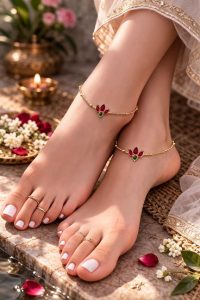
Anklets, known as payal or pajeb, are worn around the ankles and often feature delicate chains, bells, or charms. Besides their musical tinkle, anklets hold cultural importance, denoting marital status in some communities and adding a graceful finish to the feet. Anklets are usually made of silver and may include small bells that produce a soft, pleasant sound while walking. They are commonly worn by brides and young women during weddings, festivals, and cultural events. The gunguroo , another form of payal ,is a traditional percussive element in Indian classical dance. It has larger tinkling bells that aid the dancers with the beats.
The Parfois SS26 collection uses the gunguroos for rings, belts and on dresses. It is an innovative way to use the tinkling bells.
Nose Ring
The Nose Ring, also known as nath or nathni, is a traditional ornament worn on the nose.In fact, Jean Paul Gaultier 2017 collection included the sari inspired dresses with the nosering or nath.
It is one of the oldest and most culturally significant pieces of jewellery in India.In many parts of India, the nose ring is considered an important part of bridal jewellery. Brides often wear large and decorative nose rings during weddings, sometimes attached to the hair or ear with a delicate chain.
The practice of wearing a nose ring is believed to have become popular in India during the period of the Mughal Empire, when it was introduced from the Middle East and later became an integral part of Indian culture. Over time, different regions developed their own styles of nose rings, varying in size, design, and the side of the nose on which they are worn.Today, nose rings are worn not only for traditional reasons but also as a modern fashion accessory. They come in many forms such as small studs, hoops, and elaborate rings, and are popular among women of different cultures and age groups.
Jhumka
Jhumka
-Indian Bridal Jewellery
In the Paris fashion week that was held recently ,Ralph Lauren’s Fall 2026 line featured the jhumk