Connect with us

BBC News World

Shot in school uniform: BBC reveals police order led to Gen Z protest killings in Nepal

New evidence reveals what happened when 19 people were shot dead in Kathmandu last September.​New evidence reveals what happened when 19 people were shot dead in Kathmandu last September. 

Shot in school uniform: BBC reveals police order led to Gen Z protest killings
Subina Shrestha,BBC Eye Investigationsand
Deepak Kharel,BBC Eye Investigations
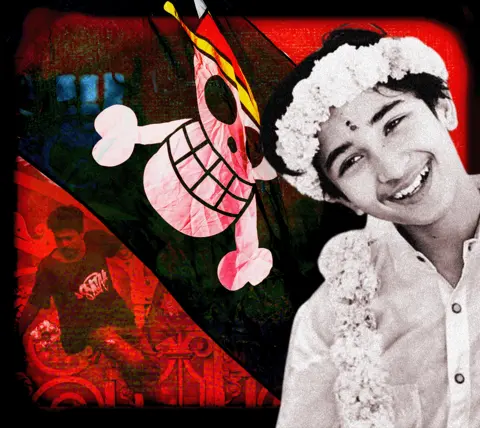
BBC A digitally edited collage featuring three main elements: on the left, a person in motion wearing a black shirt with stylised white text against an ornate red background; in the centre, a large black pirate flag displaying the Straw Hat Pirates’ Jolly Roger from manga series One Piece with a skull wearing a straw hat; and on the right, a black-and-white photo of a smiling teenage boy wearing a white shirt and floral garlands. The overall colour scheme is dominated by red and black tones.BBC

An order allowing the use of lethal fire against thousands of young, unarmed protesters in Nepal was issued by the country’s former police chief, a BBC investigation reveals.

Among the 19 people killed in the capital, Kathmandu, on 8 September last year was a teenager in school uniform, who had been walking away from the crowd when he was shot in the back of the head. Dozens more were injured.

The events at the so-called Gen Z demonstrations – which had followed weeks of simmering anger about political corruption – sparked further protests leading to the resignation of Nepal’s prime minister and the collapse of its government a day later.

The BBC World Service team has seen an internal police document detailing events on 8 September. It reveals someone using the call sign “Peter 1” told his officers to “deploy necessary force” 10 minutes after a curfew had come into effect, and after repeated requests by officers on the ground to use lethal force.

Peter 1 was the call sign used by Nepal’s former police inspector general, Chandra Kuber Khapung, sources have told BBC Eye Investigations.

Khapung has not denied that he issued the order, but Nepal Police says that this was only after he was given authorisation by a government security committee and once all other forms of force had been used, in line with Nepali law.

Khapung – who retired in November – has not replied to the BBC’s request for comment.

Video evidence examined by the BBC reveals that 17-year-old Shreeyam Chaulagain – the youngest of the 19 victims – had been unarmed and was trying to leave the scene when he died.

The events of 8 September are now being examined by a public inquiry, which has yet to report. So far, no-one has been held accountable – and general elections are set to take place on 5 March.

The BBC has established the chain of events, detailed by the leaked police log and supported by insider accounts from serving officers, that led to the shootings.

By analysing visual evidence, including more than 4,000 videos and photos, and details from those on the streets and in the command centre where security officials were monitoring events, we have pieced together the most comprehensive account so far of one of the most dramatic and bloody days in Nepal’s recent history.

Warning: This story contains images of dead bodies

Nepal is a young democracy. It became a republic in 2008, after a civil war that killed more than 17,000 people and lasted 10 years.

A decade after a new constitution promised a fresh start, many young people say those hopes remain unmet. By some estimates, about one in five young Nepalis is out of work.

Much of the frustration has been voiced online, particularly among Generation Z – those currently aged between 14 and 29.

Last August, Gen Z activists began to share terms on social media such as “nepo baby”, to describe the privileged children of the Nepalese elite. On 4 September, the government banned some platforms, including Facebook, YouTube, Instagram and X.

Activists moved onto the gaming chat platform Discord, which became a hub for organising.

In one forum, Youth Against Corruption, members planned the protest outside parliament on 8 September.
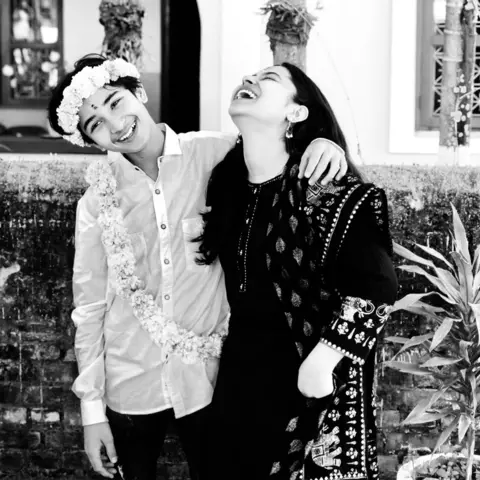
A black‑and‑white photo showing a teenage boy and a woman standing close together outdoors, one with an arm around the other. He is smiling, and she is laughing, her head back in the air. He is wearing a light-colored button‑up shirt and a long floral garland draped across the torso. She is wearing a dark, patterned outfit with embroidered details on the sleeves and a matching draped fabric. They stand in front of a textured brick wall, with plants and parts of a building visible in the background.

Shreeyam Chaulagain’s mother did not want him to go.

“I told him not to participate. Things can happen at protests,” she told the BBC. But Shreeyam was deeply engaged with politics, his father said. “He said corruption had hollowed out [Nepal]. He was far more informed than I was.”

Shreeyam reassured his mother the protesters would not be targeted because they were young, and in school uniforms.

“He was so curious – he wanted to know what was going on in the world,” she said.

The hours that led to bloodshed

09:00: Young people begin gathering at Maitighar Mandala, a busy intersection in central Kathmandu where demonstrations are often held.

A barricade stands several hundred metres from parliament.

Security officials “hugely underestimated the crowd”, says Basanta Basnet, editor of Nepal’s daily online news portal Online Khabar. “I spoke to security personnel, and also to members of the political class – they said that ‘children’ were joining.”
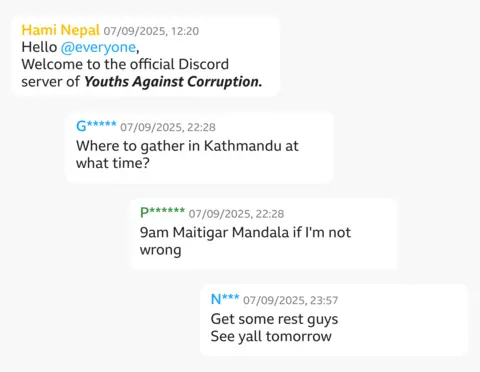
A screenshot of a Discord conversation featuring several chat bubbles. The first message, from a user labelled “Hami Nepal” dated 07/09/2025 at 12:20, welcomes everyone to the official Discord server of Youths Against Corruption. A later message from a user labelled “G*****” on 07/09/2025 at 22:28 asks where and when to gather in Kathmandu. Another user, “P******”, replies at the same timestamp saying: “9am Maitigar Mandala if I'm not wrong.” The final message, from “N***” at 23:57, says: “Get some rest guys. See yall tomorrow.”

About 30,000 people arrive to protest – 10 times the number anticipated by police.

“We have an expected behaviour pattern [for protests],” one police officer has told the BBC anonymously. “But with this new generation, we do not understand their social media or how they mobilise on the ground.”

The protesters begin moving towards parliament, but are stopped by the police barricade.

11:47: A group of demonstrators finds a way around the cordon – the police, taken by surprise, abandon the barricade.

The crowds surge past and protesters reach the gates of parliament.

12:15: One group of protesters breaches the walls of the parliament compound. Police fire tear gas and use batons. The crowd does not retreat, even as organisers urge people on Discord to pull back.

Video footage shows Shreeyam outside the gates. Wearing a green school jumper and carrying a backpack, he holds a banner reading: “Youths Against Corruption”.

Elsewhere, the protests are becoming more violent.

Inside the situation room

Senior security officials are gathered in a control room almost 3km (1.9 miles) away, near a complex of government offices.

Representatives of the civilian police, army, armed police and intelligence officials are present. The security committee is chaired by the capital’s chief district officer, senior civil servant Chhabi Lal Rijal.

Within the command centre, officials work to obtain live visual feeds from CCTV cameras positioned around the parliamentary complex. According to one anonymous officer, they have a TV but no dedicated internet line, and that when they attempt to establish a connection, it is “not stable”.

No individual or unit has a comprehensive understanding of the overall situation, according to police officers we speak to who were there on the day.

12:30: The chief district officer imposes an immediate curfew, making the protests illegal. Officers use loudhailers to order people home.

Rather than obeying, some protesters surround a police unit and pelt them with bricks and stones.

About the same time, footage shows the parliament gatehouse on fire.

According to multiple police sources and the police log, panicked officers in and around parliament radio the command centre for help. “Some of us were badly hurt. One of us asked to be rescued,” one anonymous police source tells us.

They repeatedly ask their superiors for permission to use live ammunition, after batons, water cannons and rubber bullets fail to disperse the crowd.

12:40: That authorisation is given now, according to the log we’ve seen, as well as several police sources.
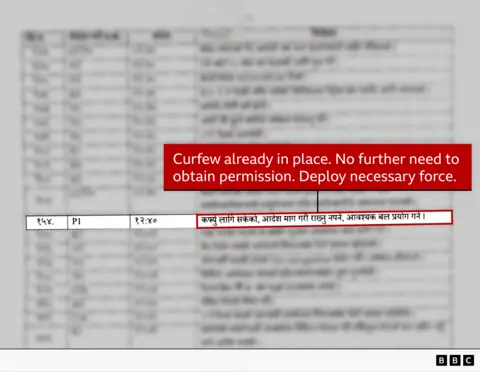
A blurred photo of a document with four columns and many rows; all the entries are written in Nepalese. One row is highlighted, with an English translation provided: "Curfew already in place. No further need to obtain permission. Deploy necessary force."

They pinpoint the source of the approval to one call sign: Peter 1.

The instruction from Peter 1 is recorded in the police log: “Curfew already in place. No further need to obtain permission. Deploy necessary force.”

Peter 1 is Chandra Kuber Khapung, then inspector general of police.

In a filing to the supreme court of Nepal, Khapung later denied responsibility, and Nepal Police told the BBC that the decision to give the order to fire was made by the committee that Rijal headed up. In a letter, the force said that Khapung “did not issue the order to use force ahead of the committee’s decision”.

In public order situations, the security committee – rather than the police – has legal authority over decisions concerning escalation of force.

However, its then chair, Rijal, has denied in court that he authorised live rounds.

Some police officers we spoke to have since acknowledged failures in intelligence, planning and command. Several said they had been unprepared for a crowd rapidly mobilised on Discord. Others questioned why military support did not arrive sooner.

Many say they are still struggling with the memory of that day.

“Our officers fired on them like they were enemies,” one says.
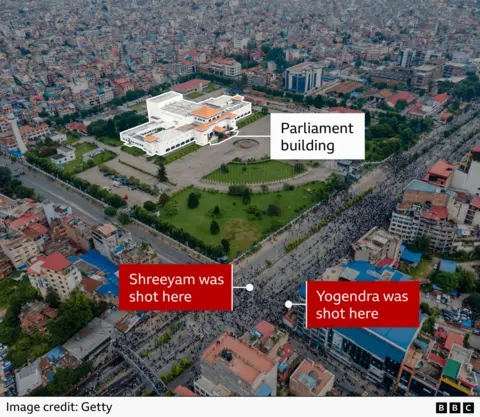
Aerial view of Kathmandu with a prominent white parliamentary building set within a green square at the centre. Surrounding the square are dense urban buildings and wide roads. Two red labels mark locations along a road crowded with people: one label on the left reads “Shreeyam was shot here,” and another on the right reads “Yogendra was shot here.” A white label above the central complex identifies the “Parliament building.”

13:15: The first death from live fire is recorded by the BBC. Video evidence shows one protester, 34-year-old Binod Maharjan, being carried away with a wound to the head. He died later in hospital.

The BBC has been able to analyse six shootings after the curfew order. In the footage we examined, we have not seen any of the victims engaging in violence.

14:09: Shreeyam – the youngest victim of the shootings that day – is seen peacefully walking away from the front line, where other protesters are pelting police with stones. Still carrying his school bag, he claps his hands – a gesture that appears calm.

A bullet strikes the back of his head, and he falls to the ground.
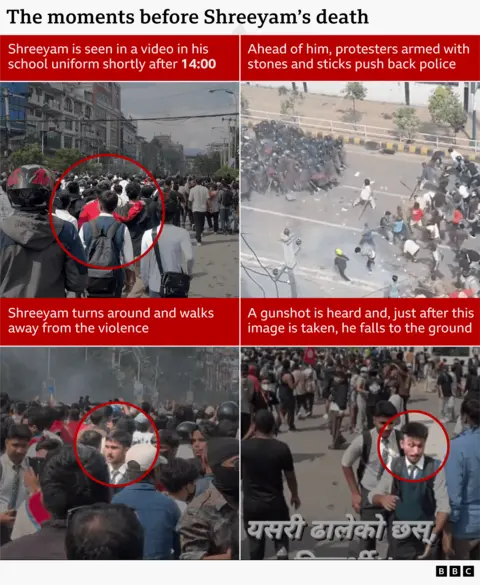
A graphic divided into four quarters, each of which consists of a photo and a caption. The top left shows a crowd, with their backs to the camera. One person is circled in the photo, Shreeyam - he is wearing a white shirt, a green tank top and a plain black rucksack. The caption reads: "Shreeyam is seen in a video in his school uniform shortly after 14:00." The next image, top right, is shot from the air and shows a group of police officers in riot gear walking towards the left; a crowd of protesters armed with sticks is following them. The caption reads: "Ahead of him, protesters armed with stones and sticks push back police." The image in the bottom left shows a crowd - Shreeyam is circled, in the centre, walking away from the protests. The caption reads: "Shreeyam turns around and walks away from the violence." The final image, bottom right, shows Shreeyam, circled, as he jolts forward. The caption reads: "A gunshot is heard and, just after this image is taken, he falls to the ground."

14:21: Video evidence obtained by the BBC shows police firing at protesters from inside the parliamentary complex. We have been able to establish that police fired seven shots at the crowd.

Protesters scatter, ducking into the gaps between buildings and pavement. Some simply cover their heads for protection. Yogendra Nyaupane, 24, is hit and fatally wounded.

The last shooting recorded by the BBC takes place at about 16:00, and the protest outside parliament dies down at dusk. But smaller sporadic protests continue through the night.
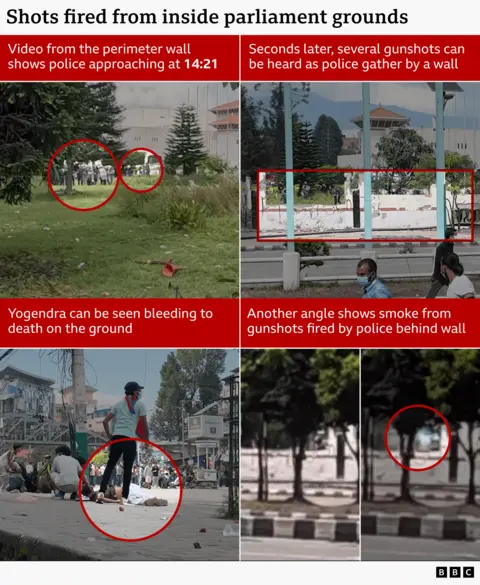
A graphic divided into four quarters, each of which consists of a photo and a caption. The heading reads "Shots fired from inside parliament grounds". The top left shows a grassy area, inside the parliament compound. In the distance, there is a group of police officers in riot gear, circled in red. The caption reads: "Video from the perimeter wall shows police approaching at 14:21". The next image, top right, shows a group of police officers in riot gear just behind the parliament wall. The caption reads: "Seconds later, several gunshots can be heard as police gather by a wall." The image in the bottom left shows a group gathered around a person lying on the pavement. The caption reads: "Yogendra can be seen bleeding to death on the ground." The final image, bottom right, is split into two. Both show trees in front of the parliament walls - on the right, smoke can be seen. The caption reads: "Another angle shows smoke from gunshots fired by police behind wall."

Angered by the killings at the gates of parliament on 8 September, Nepalis of all ages took to the streets the following day. What had begun as protest rapidly hardened into mob violence, and police became immediate targets. Police stations were set ablaze, officers were assaulted, and three were killed.

There were arson attacks on the parliamentary compound, the supreme court and other government buildings. In total, 77 people were killed during the unrest.

Although it has been widely alleged – by politicians, police and protesters – that organised groups and infiltrators acting on behalf of political interests helped drive the destruction, we have found no evidence to substantiate the claim.

At about 14:30 on 9 September, Prime Minister KP Sharma Oli resigned and Nepal’s government collapsed. By nightfall, buildings were burning across Kathmandu, and at least 50 more people were reported dead.

The army took control at 21:00.

No-one has yet taken responsibility for what happened.

Ramesh Lekhak, the then home minister, and former Prime Minister Oli, have denied responsibility as well as Khapung and Rijal.

Nepal Police told the BBC that they “were faced with an overwhelming situation where we had to respond to multiple incidents simultaneously”.

Meanwhile, families of all the victims are waiting for justice. Shreeyam’s mother, Karki, says she has not been able to cry.

“I don’t feel he’s gone yet – I still feel he’ll be back soon,” she tells us. “In my mind, he’s in his school uniform. He’ll return, swinging his bag.”


Continue Reading
Click to comment

Leave a Reply

Your email address will not be published. Required fields are marked *

BBC News World

G7 nations to hold emergency meeting on oil as stock markets fall
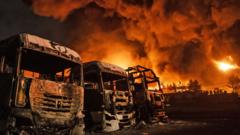
​ G7 nations to hold emergency meeting on oil as stock markets sink. Just now. Faisal Islam,Economics editor,. Peter Hoskinsand. Nick Edser,Business reporters. Anadolu via Getty Images. G7 nations will hold an emergency meeting on Monday to discuss surging oil prices as crudejumped above $100 a barrel and stock markets slumped over the escalating US-Israeli war with Iran.. Finance ministers from leading industrialised countries, including UK Chancellor Rachel Reeves, will gather to discuss the economic impact of the conflict.. Global oil prices reached nearly $120 on Monday over fears of a prolonged disruption to energy supplies through the key Strait of Hormuz shipping route and the UK’s FTSE 100 share index fell 1.3%.. The Financial Times reported the G7 meeting will discuss a joint release of petroleum from reserves, co-ordinated by the International Energy Agency (IEA).. If reserves are released by IEA members it would be the first time since 2022, when action was taken following Russia’s full-scale invasion of Ukraine.. Major disruption to energy supplies from the region threatens to push up prices for consumers and businesses around the world. Rising inflation could lead to fewer interest rate cuts by central banks.. About a fifth of the world’s oil supply is usually shipped through the Strait of Hormuz. But traffic through the narrow passage has all but halted since the war started more than a week ago.. On Sunday, Iran named Mojtaba Khamenei to succeed his father Ali Khamenei as Supreme Leader, signalling that more than a week into the conflict hardliners remain in charge of the country.. The US and Israel launched fresh waves of airstrikes across Iran over the weekend, hitting multiple targets including oil depots.. Meanwhile, Iran targeted energy infrastructure in neighbouring Gulf states. Overnight, Saudi Arabia said it had intercepted and destroyed two waves of drones heading towards a major oilfield.. Follow the latest developments on the war in the Middle East. Last week the markets had been relatively relaxed about the seemingly nightmare scenario of millions of barrels of crude and liquefied gas trapped in the Gulf, unable or unwilling to transit the Straits of Hormuz.. But the escalations over the weekend, alongside scenes of destruction of energy infrastructure both in Iran and across the Gulf, saw the markets take rapid fright.. On Monday morning in Asia, the price of Brent crude jumped by more than 25% to touch $119.50 a barrel at one point before falling back to around $107.. US West Texas Intermediate (WTI) crude saw similar movements and was trading at about $104 a barrel.. “The question everyone is asking themselves is, what is the duration of this conflict?” Paul Gooden, head of natural resources at NinetyOne Asset Management, told the BBC’s Today programme.. “The longer it goes on, the more nervous the oil markets are going to be.”. He added that the oil price could rise to a level where “you see so-called demand destructi  

Continue Reading

BBC News World

Guinea opposition leader urges ‘direct resistance’ after 40 parties dissolved

​ Guinea opposition leader urges ‘direct resistance’ after 40 parties dissolved. 43 minutes ago. Jean Otalor. AFP via Getty Images. Guinea’s main opposition leader Cellou Dalein Diallo has said that “direct resistance” to the country’s coup leader–turned–president is now the only remaining path to change, after the authorities dissolved 40 political parties.. The authorities accused the parties of not complying with the law – a charge they have rejected.. The move comes two months after former junta head Mamady Doumbouya was sworn-in as president, following an election that saw some key challengers barred from running.. Doumbouya, who came to power in 2021 after overthrowing Condé, has been accused of cracking down on democratic freedoms.. Among the parties dissolved were the the Rally of the People of Guinea of former President Alpha Condé and Diallo’s Union of Democratic Forces of Guinea. Diallo is currently in exile.. Late last Friday, Guinea’s ministry of territorial administration and decentralisation announced in a decree that the headquarters and local offices of 40 political parties would be closed, and their logos, acronyms and other symbols banned from use.. The parties’ assets have been confiscated and all offices sealed.. The ministry said the parties had failed to comply with legal requirements, including submitting mandatory financial statements. Several of the dissolved groups have rejected the allegations, insisting they met all obligations under the law, the Reuters news agency reported.. In a video statement released on social media on Sunday, Diallo said the decree showed that “war has been openly declared” on those challenging President Doumbouya.. He said political change would not happen through dialogue or democratic processes.. “The head of the junta and his malevolent clique want to rewrite the country’s history by erasing from the political landscape all forces likely to overshadow his nascent one-party state,” he added.. Jean-Marc Telliano, a former minister and president of the Rally for the Integrated Development of Guinea, also criticised the decision. Reuters quoted him as saying that his party would fight to assert its rights and “will use all legal means to have our rights restored”.. More about Guinea from the BBC:. From camouflage to tracksuits – Guinea’s junta leader becomes civilian president. US film stars Meagan Good and Jonathan Majors become Guinea citizens after DNA tests. From Hollywood to the homeland: Why African countries are courting black American stars. Getty Images/BBC. Go to BBCAfrica.com for more news from the African continent.. Follow us on Twitter @BBCAfrica, on Facebook at BBC Africa or on Instagram at bbcafrica. BBC Africa podcasts. Focus on Africa. This Is Africa. Guinea. Africa  

Continue Reading

BBC News World

Australia urged to protect Iran women’s football team as they prepare to fly home
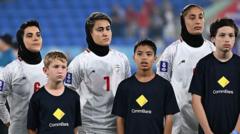
​ Australia urged to protect Iranian football team after Asian Cup elimination. 6 hours ago. Katy Watsonand. Simon Atkinson,reporting from the Gold Coast. Getty. Football’s governing bodies and Australian authorities are being urged to ensure the safety of Iran’s women’s team as they prepare to fly home from Australia after being eliminated from the Asian Cup.. Hundreds of supporters surrounded the Iranian Lionesses’ coach as it left the stadium on the Gold Coast on Sunday evening, with chants of “save our girls”.. Fears for Iran’s women’s team grew after they declined to sing the national anthem ahead of their first match against South Korea last week.. This prompted criticism from within Iran, with one conservative commentator accusing the team of being “wartime traitors” and pushing for harsh punishment.. “We all have very reasonable and serious concerns for their safety,” said Craig Foster, a former captain of the Australian men’s football team and prominent human rights advocate.. He told the BBC: “When any team participates in a Fifa-regulated tournament, whether Asian Football Confederation or any other confederation, they must have the right to safety and external support to express any concerns they have around their safety now or in future.”. In their second match against Australia and then again in Sunday’s final game against the Philippines, the Iranian team sang and saluted during the national anthem, leading critics to believe they’d been forced to take part by members of the ‘Islamic Revolutionary Guard Corps accompanying them as part of the delegation.. Deniz Toupchi, who travelled to support the team for their final match, said of the decision to initially stay silent: “We didn’t expect it to be honest because we know it’s a really major [thing] to do.”. She added: “We’re just proud of them.”. Toupchi was one of hundreds of members of Australia’s Iranian community in the stands on Sunday. During the anthem, which they do not recognise, they booed and jeered.. Midway through the first half, many also unfurled the Lion and Sun flag, which served as the official state flag before the Islamic revolution in Iran. These had been snuck into the stadium in defiance of signs outside which said only Iran’s current official flag could be displayed.. But while the fans enthusiastically supported the players, there was very little interaction between them and the team during the match.. In one notable exception, a player receiving medical attention on the sidelines blew a kiss to the stands, receiving a huge cheer.. And while the Filipina team lined up to thank their fans at the end of the match, the Iranians left the pitch promptly.. “They can’t speak freely because they are threatened,” said Naz Safavi, who attended all three matches in which the team played. “We are here to show them that we are fully supporting them.”. Getty. With concern rising over the players’ treatment once they return home, there is a push to support the women to seek  

Continue Reading

BBC News World

N Korea cancels Pyongyang Marathon for ‘some reasons’
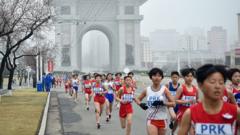
​ N Korea cancels Pyongyang Marathon for ‘some reasons’. 1 hour ago. Sofia Ferreira Santos. AFP via Getty Images. North Korea has cancelled the Pyongyang marathon for unspecified reasons, a tour agency linked to the event has said.. British-owned Koryo Tours, which describes itself as the official partner of the marathon, said on Monday that it had received notice of the cancellation from North Korea’s athletics association.. A message it attributed to the association said the marathon was being cancelled “due to some reasons”.. The annual event was established in 1981 to celebrate the birth of North Korea’s founding leader Kim Il Sung. The 2026 race was set to take place on 5 April.. N Korea holds first international marathon in six years. The message, purportedly from the North Korea athletics association’s general secretary, thanked “all the Elite Marathoners and Amateur Runners of the world who are interested in Pyongyang International Marathon”.. The message gave no further explanation on what the reasons for the cancellation were.. Koryo Tours said it understood the decision was final and had been taken “at a level above the organisers of the event itself”.. It said it would be seeking clarification on the circumstances surrounding the decision.. The tour company added that neither organisers nor event partners were involved in making the decision, and said it recognised “this announcement will be disappointing to many runners who had already registered or were planning to participate”.. Koryo Tours, based in Beijing, China, offers several marathon packages to foreigners, departing from Beijing, Shanghai and Shenyang.. Packages start from €2,190 ($2,529; £1,894) for 2.5 nights in the North Korean capital, Pyongyang, including a marathon place and “highlights” of the capital and tickets were sold out this year, according to the agency’s website.. It said all deposits paid will be returned and runners have the option to retain their deposit for a future event or North Korea tour.. A date for the 2027 marathon has not yet been set.. The event had only returned last year after it was suspended for five consecutive years due to the Covid pandemic.. It is open to both amateur and some professional athletes and offers several race distances – 5km (3.1 miles), 10km (6.2 miles), half marathon (21.1km; 13.1 miles) or full marathon (42.2km; 26.2 miles).. Asia. Marathon running. Pyongyang. North Korea  

Continue Reading

BBC News World

Istanbul’s ex-mayor on trial for corruption charges
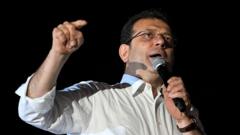
​ Istanbul’s ex-mayor on trial for corruption charges. 1 hour ago. Alys Davies. AFP via Getty Images. The former mayor of Istanbul has appeared in court asthe central defendant in a mass corruption trial thathis opposition party and rights groups say is politically motivated.. Ekrem Imamoglu, 55, faces more than 140 charges including corruption and running a criminal organisation. Prosecutors are seeking a jail term of up to 2,430 years.. He and his Republican People’s Party (CHP) deny any wrongdoing. They accuse Turkish President Recep Tayyip Erdogan and his allies of launching a crackdown over the leader’s decline in popularity.. Prior to the trial, which got off to a chaotic start on Monday, Imamoglu was widely seen as one of the few politicians capable of defeating Erdogan, who has been at the top of Turkish politics since 2003.. Another 407 of Imamoglu’s supporters have also been put on trial, accused of running a criminal corruption network headed by the opposition figure, who prosecutors describe as its “founder and leader”.. Imamoglu was greeted by his supporters with cheers and whistles as he entered the courtroom in the Marmara prison on Monday.. But it was not long before proceedings were brought to a halt by the judge after the politician contested the judge’s decision to hear the testimony of other defendants before his in the trial.. The judge called the protest disrespectful and ordered a recess until the afternoon, just 15 minutes after the hearing had started.. Present in the courtroom were Imamoglu’s wife, Dilek, and CHP leader Ozgur Ozel.. Imamoglu was arrested in March last year on the day he was named as the CHP’s presidential candidate for 2028.. His detention triggered the country’s largest street protests in more than a decade, followed by hundreds of arrests and a police crackdown.. Who is Turkish opposition leader Ekrem Imamoglu?. Turkey moves to silence jailed Erdogan rival by blocking account on X. Apart from the corruption case, prosecutors have accused him of a raft of other offences including espionage and forging his university degree, a qualification he would need to become president and that has since been annulled.. Turkish authorities deny that the judiciary is being used as a political tool.. But the trial has been strongly criticised by rights groups.. “The trial of Mayor Ekrem Imamoglu follows more than a year of weaponising the criminal justice system against his party and other CHP elected officials while he sits in jail,” Benjamin Ward, deputy Europe and Central Asia director at Human Rights Watch, said in a statement last week.. “Looking at these cases as a whole, it’s hard to avoid the conclusion that prosecutors are trying to remove Imamoglu from politics and discredit his party in ways that undermine democracy.”. Amnesty International called the charges brought against Imamoglu “absurd”.. “This politically motivated prosecution, which is based almost entirely on secret witness testimony, is riddled with  

Continue Reading

Latest News

Politics1 hour ago

Madhya Pradesh Cong MLA’s election cancelled for failing to declare criminal cases

 The Madhya Pradesh high court said Mukesh Malhotra’s failure to declare criminal cases in his election affidavit amounted to a...

Politics3 hours ago

Restaurants face LPG supply crisis, NRAI warns of ‘catastrophic closures’

 Restaurants across various parts of the country have reported shortage in the supply of commercial cooking gas, with the National...

Politics3 hours ago

Restaurants face LPG supply crisis, NRAI warns of ‘catastrophic closures’

 Restaurants across various parts of the country have reported shortage in the supply of commercial cooking gas, with the National...

Politics3 hours ago

Sensex, Nifty today LIVE: Shares expected to open higher day after bloodbath as Trump hints war could end soon

 Sensex, Nifty today LIVE updates: Investors are keeping a close watch on the markets after Monday’s, March 9’s, sharp sell-off,...

Politics3 hours ago

Sensex, Nifty today LIVE: Shares expected to open higher day after bloodbath as Trump hints war could end soon

 Sensex, Nifty today LIVE updates: Investors are keeping a close watch on the markets after Monday’s, March 9’s, sharp sell-off,...

Politics3 hours ago

Sensex, Nifty today LIVE: Shares expected to open higher day after bloodbath as Trump hints war could end soon

 Sensex, Nifty today LIVE updates: Investors are keeping a close watch on the markets after Monday’s, March 9’s, sharp sell-off,...

Politics3 hours ago

Sensex, Nifty today LIVE: Shares expected to open higher day after bloodbath as Trump hints war could end soon

 Sensex, Nifty today LIVE updates: Investors are keeping a close watch on the markets after Monday’s, March 9’s, sharp sell-off,...

Politics3 hours ago

Sensex, Nifty today LIVE: Shares expected to open higher day after bloodbath as Trump hints war could end soon

 Sensex, Nifty today LIVE updates: Investors are keeping a close watch on the markets after Monday’s, March 9’s, sharp sell-off,...

Politics3 hours ago

Sensex, Nifty today LIVE: Shares expected to open higher day after bloodbath as Trump hints war could end soon

 Sensex, Nifty today LIVE updates: Investors are keeping a close watch on the markets after Monday’s, March 9’s, sharp sell-off,...

Politics4 hours ago

Union minister urges Telangana to work with NTPC to fulfil power demand

 Union minister for coal and mines G Kishan Reddy on Monday asked the Telangana government to enter into a power...

Trending News

Join Our Newsletter

Stay updated with breaking news and exclusive content.