


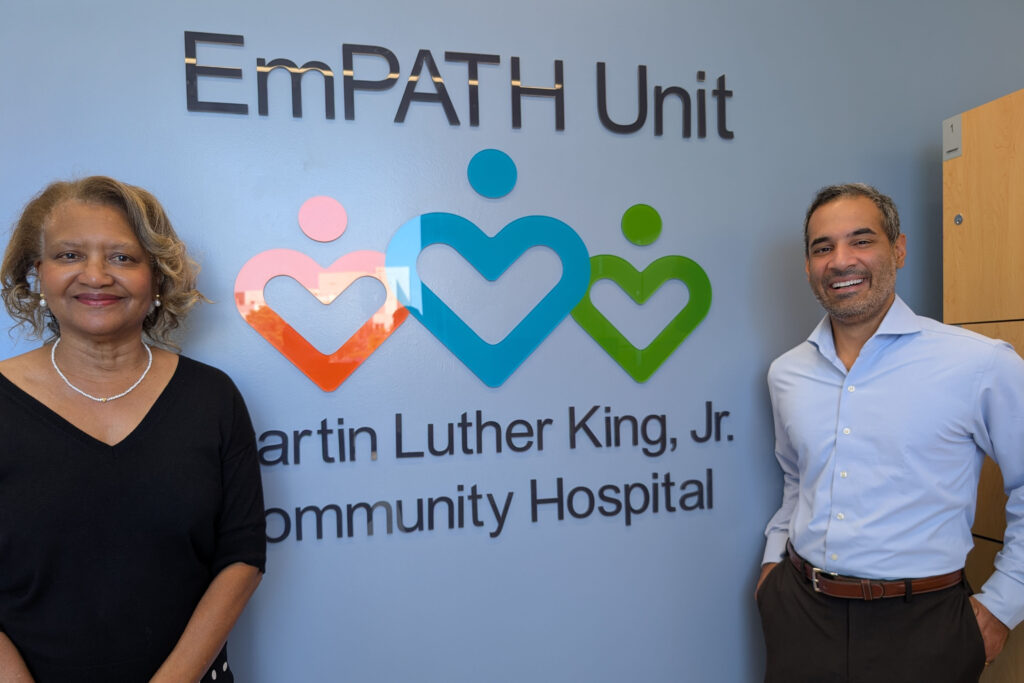
LOS ANGELES — At Martin Luther King, Jr. Community Hospital, patients on gurneys line the hallways of the emergency department waiting for care, and overflow mental health patients are consigned to outdoor tents.
The 152-bed hospital, which sits on a sprawling medical campus close to the predominantly Latino and Black neighborhood of Watts, is struggling for financial stability. Its patients are poorer and sicker than average, many of them are uninsured, and three-quarters of MLK’s patient care revenue comes from Medi-Cal, the state’s version of the Medicaid program, which pays low rates. For hospitals statewide, by comparison, less than one-third of patient revenue comes from Medi-Cal.
And MLK Community Healthcare, which comprises the hospital and two nearby clinics, is independent, so it cannot fall back on a larger chain to absorb some of the financial pressure.
Similar problems plague hundreds of financially vulnerable hospitals around the country, in rural and urban areas. And their financial woes are about to get worse.
The Republican budget measure known as the One Big Beautiful Bill Act, signed into law by President Donald Trump last July, is expected to cut federal Medicaid spending by $911 billion over 10 years. And it could contribute to an increase of more than 14 million in the number of uninsured people, many of whom will go to already crowded emergency rooms to get care they can’t pay for.
The law does include a special fund to boost rural healthcare, totaling $50 billion over five years. But that’s far less than the $137 billion it is expected to cut from rural health spending over the next decade. And the rural health fund does little or nothing to help the numerous urban hospitals, such as MLK, that also face serious financial troubles.
MLK, like many other hospitals, is scrambling to secure outside financing to avert serious disruptions of medical services when the brunt of the policies contained in the federal law begins to hit early next year. The hospital’s leadership team projects a revenue hole of $80 million to $100 million annually for the foreseeable future. It would be MLK’s largest budget gap since it opened in 2015.
“Even if we cut services that our community needs — maternity care, behavioral healthcare, diabetes management — it wouldn’t make a significant dent in the gap we’re facing,” said Elaine Batchlor, the CEO of MLK Community Healthcare. ”Many of those same people would still come to us through our emergency department, only they’d be in worse shape and might need more expensive care.”
MLK Community Healthcare CEO Elaine Batchlor stands outside the check-in area for Martin Luther King, Jr. Community Hospital’s emergency department, a long tent outside the main building in Los Angeles. (Bernard J. Wolfson/KFF Health News)
Across the U.S., hospitals and patient advocates are looking to state lawmakers and local officials to help shore up shaky fina