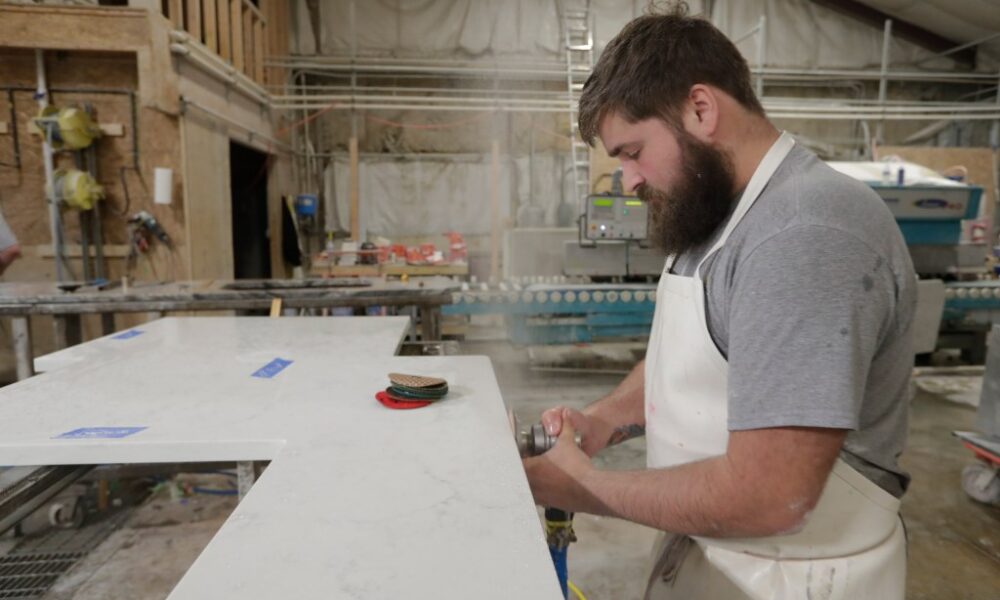
César Manuel González, 37, used to work with stone that was engineered to endure: dense, polished slabs designed to outlast the kitchens in which they were installed.
Engineered quartz countertops have surged in popularity in the home renovation market, with industry analysts estimating the global engineered stone market at around $30 billion. It’s continuing to expand as quartz surfaces replace natural stone in kitchens in the United States and worldwide.
When González was working, the dust that rose from his saw didn’t look extraordinary. It settled on his clothes, in his hair, across the shop floor. In a small countertop fabrication shop, he cut marble and granite before shifting to engineered stone after the 2008-09 recession, when demand for cheaper quartz countertops surged.
But the crystalline silica released while the engineered stone was cut and polished also settled into his lungs, scarring them beyond repair. What began as breathlessness hardened into silicosis, an irreversible disease that stiffens the lungs until even ordinary movement becomes effort.
A lung transplant was his path forward. The procedure can extend survival, but it redraws the boundaries of a life: anti-rejection drugs every day, constant monitoring, vulnerability to infection, the knowledge that breathing depends on the fragile acceptance of another person’s donated organ.
González, who was diagnosed with silicosis in 2023, is not alone in dealing with a disease that once was associated with miners at the end of long careers. It’s now prevalent among the much younger, often Hispanic men who work in this industry, physicians and public health officials say.
In the United States, cases are appearing in countertop fabrication shops from California to Texas, Florida, and the Northeast. Because silicosis is not a nationally reportable disease and surveillance varies by state, no comprehensive national count exists. But clinicians who treat occupational lung disease say the number of workers — often men in their 30s and 40s — diagnosed after cutting engineered stone has risen sharply over the past decade.
As of early March, California had identified 519 confirmed cases of engineered-stone-associated silicosis and 29 deaths since 2019. The median age at diagnosis is 46; at death, 49.
Doctors don’t debate whether working with engineered stone can scar lungs.
Manufacturers argue, though, that proper ventilation, wet cutting, and respirators can make fabrication safe. Workers, physicians, and plaintiffs’ attorneys counter that a material composed almost entirely of crystalline silica may be impossible to handle safely at scale.
“This is comparable to the tobacco industry saying cigarettes are safe,” said epidemiologist David Michaels, an assistant labor secretary under President Barack Obama who led the Occupational Safety and Health Administration.
More than 370 lawsuits have been filed by workers who say