Connect with us

HealthNews

RFK Jr. Swaps Vaccine Talk for Healthy Foods and Reading to Tots in Push To Woo Voters
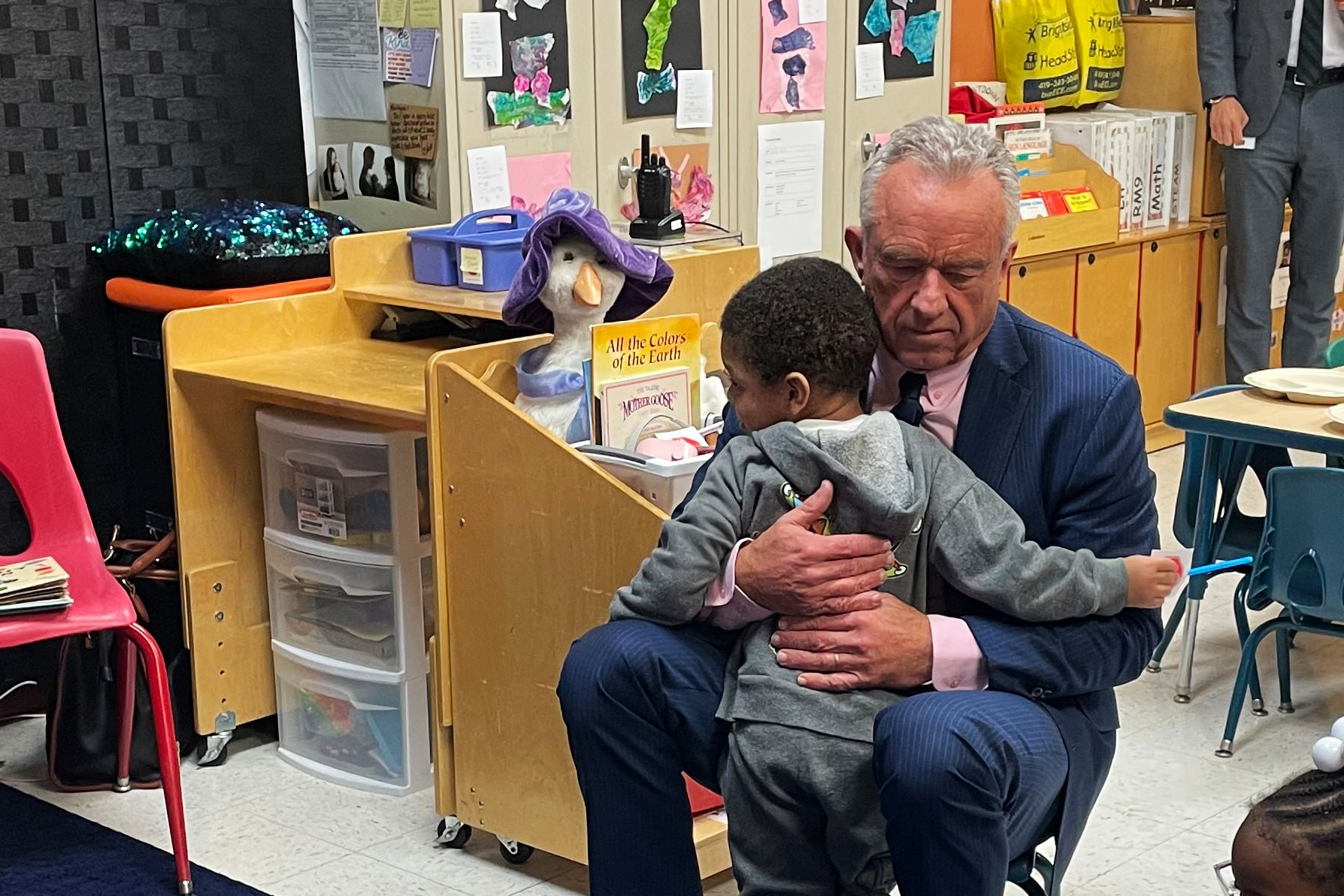
​TOLEDO, Ohio — The little boy, dressed in a Toy Story sweatshirt, wrapped himself around the nation’s health secretary.

“What do you guys want to be when you grow up?” Health and Human Services Secretary Robert F. Kennedy Jr. asked a carpet full of preschoolers.

“A dinosaur!” the boy replied, squeezing tighter.

Just weeks ago, Kennedy sat before lawmakers on Capitol Hill and faced intense questions about a dangerous uptick in infectious diseases among American children.

Now, with midterm primaries underway, Kennedy was seated in a toddler-sized chair in Ohio, on a mission to change the subject.

Advised to stay away from the anti-vaccine rhetoric that rocketed him to political stardom, Kennedy has been dispatched by the White House to evangelize about the least controversial — and most popular — parts of his agenda. Republicans hope Kennedy’s “Take Back Your Health” tour will help them hang on to voters, many of whom are deeply unhappy with President Donald Trump.

So there Kennedy was in early May, crisscrossing a strip of northern Ohio that includes one of the few congressional districts that Republicans are confident they can flip in November, rotating through a wardrobe of blue suits and blue jeans.

He inspected the kitchen of a Toledo daycare center, where hundreds of the city’s tiniest residents learn and play through the federally funded Head Start program. Under the careful watch of a surgeon, he briefly operated the renowned Cleveland Clinic’s robotic hands on a live patient splayed open for heart surgery. And he munched on pesticide-free squash blossoms from a 400-acre farm.

Kennedy samples microgreens at a Huron, Ohio, farm that rejects chemical use in growing its produce. Reducing the use of chemicals in food production is a goal of many supporters of the Make America Healthy Again movement. (Amanda Seitz/KFF Health News)

“I am dismantling a corrupt system and replacing it with something better, replacing it with something that actually addresses the declining healthy American population,” Kennedy said from the dining room table of a farmhouse during an exclusive interview with KFF Health News. He pointed to what he views as his biggest accomplishments over the past year: pressuring some companies to remove dyes from certain foods, updating nutritional guidance, and defining ultraprocessed foods.

“People are paying attention to what they eat, and the industry is listening; the industry is changing.”

But hundreds of miles from Washington’s partisan interrogations, Kennedy couldn’t escape the uncomfortable contradictions and consequences of the Trump administration’s policies.

Taboo Budget Cuts

The classrooms of the Clever Bee Academy displayed freshly printed posters featuring Kennedy’s “Eat Real Food” slogan and the redesigned food pyramid.

Kennedy came with an offering, a $30,000 federal grant to help the center upgrade its kitchen and community  

Continue Reading
Click to comment

Leave a Reply

Your email address will not be published. Required fields are marked *

HealthNews

Trump’s Drug Strategy Aims To Bolster Addiction Services — Despite Gutting of Government Support

​The White House’s newly released strategy for tackling the nation’s drug and addiction crisis calls for a number of ambitious public health approaches that some experts say are laudable but will be hampered by the administration’s own actions.

The sweeping 195-page National Drug Control Strategy, published May 4, advocates for making access to treatment easier than getting drugs, preventing young people from developing addictions in the first place, increasing support for people in recovery, and reducing overdose deaths.

Those broad goals are widely supported by public health researchers, addiction treatment clinicians, and recovery advocates.

But accomplishing such goals will be difficult in the face of the administration’s mass layoffs of federal employees, cancellation of research and community grants, attacks on organizations and practices that serve people who use drugs, and cuts to Medicaid, the state-federal health insurance program for low-income people that is the largest payer for addiction and mental health care nationwide.

Many components of the National Drug Control Strategy are “things that we would agree with and that we fully support,” said Libby Jones, who leads overdose prevention efforts at the Global Health Advocacy Incubator, a public health advocacy group.

But there are “disconnects in what the strategy says is important and then what they’re actually going to fund,” she said of the Trump administration. “Those inconsistencies feel particularly loud in this strategy.”

The White House’s National Drug Control Strategy, released every two years, is a touchstone document meant to lay out the federal government’s coordinated approach to what in recent decades has been one of the country’s defining problems.

Since 2000, more than 1.1 million people have died of drug overdoses. Although deaths have decreased recently, the numbers remain elevated compared with earlier decades, and research suggests overdose death rates among Black Americans and Native Americans are disproportionately high.

The strategy document published this week is the first of President Donald Trump’s current term. In keeping with the administration’s approach to addiction issues, it places heavy emphasis on law enforcement efforts to reduce the supply of illicit drugs. The document repeatedly refers to the ongoing “war” against “foreign terrorist organizations” — the Trump administration’s term for drug cartels — and touts increased enforcement at U.S. borders.

It also outlines plans to implement artificial intelligence technologies to screen for illicit drugs brought into the country and wastewater testing to detect illegal drug use nationwide.

The second half of the strategy focuses on reducing the demand for drugs through public health prevention efforts, addiction treatment, and support for people in recovery. It promotes the role of religion in recovery and calls for the widespread   

Continue Reading

HealthNews

States Eye Aid To Prop Up Distressed Hospitals Amid Federal Medicaid Cuts

​LOS ANGELES — At Martin Luther King, Jr. Community Hospital, patients on gurneys line the hallways of the emergency department waiting for care, and overflow mental health patients are consigned to outdoor tents.

The 152-bed hospital, which sits on a sprawling medical campus close to the predominantly Latino and Black neighborhood of Watts, is struggling for financial stability. Its patients are poorer and sicker than average, many of them are uninsured, and three-quarters of MLK’s patient care revenue comes from Medi-Cal, the state’s version of the Medicaid program, which pays low rates. For hospitals statewide, by comparison, less than one-third of patient revenue comes from Medi-Cal.

And MLK Community Healthcare, which comprises the hospital and two nearby clinics, is independent, so it cannot fall back on a larger chain to absorb some of the financial pressure.  

Similar problems plague hundreds of financially vulnerable hospitals around the country, in rural and urban areas. And their financial woes are about to get worse.

The Republican budget measure known as the One Big Beautiful Bill Act, signed into law by President Donald Trump last July, is expected to cut federal Medicaid spending by $911 billion over 10 years. And it could contribute to an increase of more than 14 million in the number of uninsured people, many of whom will go to already crowded emergency rooms to get care they can’t pay for.

The law does include a special fund to boost rural healthcare, totaling $50 billion over five years. But that’s far less than the $137 billion it is expected to cut from rural health spending over the next decade. And the rural health fund does little or nothing to help the numerous urban hospitals, such as MLK, that also face serious financial troubles.

MLK, like many other hospitals, is scrambling to secure outside financing to avert serious disruptions of medical services when the brunt of the policies contained in the federal law begins to hit early next year. The hospital’s leadership team projects a revenue hole of $80 million to $100 million annually for the foreseeable future. It would be MLK’s largest budget gap since it opened in 2015.

“Even if we cut services that our community needs — maternity care, behavioral healthcare, diabetes management — it wouldn’t make a significant dent in the gap we’re facing,” said Elaine Batchlor, the CEO of MLK Community Healthcare. ”Many of those same people would still come to us through our emergency department, only they’d be in worse shape and might need more expensive care.”

MLK Community Healthcare CEO Elaine Batchlor stands outside the check-in area for Martin Luther King, Jr. Community Hospital’s emergency department, a long tent outside the main building in Los Angeles. (Bernard J. Wolfson/KFF Health News)

Across the U.S., hospitals and patient advocates are looking to state lawmakers and local officials to help shore up shaky fina  

Continue Reading

HealthNews

She Survived 2 Shootings. Research Helps Explain Why Her Pain Persists Years Later.

​In 2019, Mia Tretta, then a high school freshman at Saugus High School in Santa Clarita, California, was struck in the stomach by a round from a .45-caliber semiautomatic handgun fired by a schoolmate. Two students were killed during the attack, including her best friend, and two others were injured.

When she graduated from high school, she enrolled at Brown University, the scene of another shooting in December 2025, while she was studying for finals in her dorm room.

As messages flooded in about an active shooter on campus, she felt pain where she had been shot in the stomach. The college junior experienced a phenomenon she called “phantom bullet syndrome,” similar to phantom limb syndrome, in which someone senses something is there that is not. It occurs whenever she feels extremely stressed, she said.

“It’s crazy to say that the first time, I was the lucky one because though I got shot, I didn’t get killed,” said Tretta, now an anti-gun violence advocate who is studying public affairs and education. “And the second time, I was the lucky one because I was a few blocks away.”

Tretta represents a small but growing cohort of young people who have lived through more than one shooting. She also embodies the findings of a recent study that links gun violence exposure to chronic pain.

The study, published in BMC Public Health in January, found that both direct and indirect exposure to gun violence are linked to higher rates of chronic pain among American adults.

Rutgers University researchers studied six types of gun violence exposure: being shot, being threatened with a gun, hearing gunshots, witnessing a shooting, knowing a friend or family member who was shot, and knowing someone who died by firearm suicide. Using a nationally representative survey of 8,009 people, they found that 23.9% had pain most days or every day, while 18.8% said they had a lot of pain.

Daniel Semenza, the study’s lead author, told The Trace that whether someone has lost a person to gun violence or they’ve been shot themselves, their mental and physical health are inextricably linked.

“Your body, through the experience of post-traumatic stress, is going to feel as if it’s happening over and over and over again,” said Semenza, the director of research at the New Jersey Gun Violence Research Center and an associate professor at Rutgers University.

Tretta underwent surgeries to remove the bullet, she said, and later received a nerve block to address ongoing pain from her injuries. But the bullet fragments remain in her body years later, she said.

She was also diagnosed with psoriatic arthritis — a chronic disease causing swelling, pain, and stiffness in the joints.

“I have dealt with chronic pain, immunodeficiencies, and bodily differences ever since the shooting happened,” Tretta said. “Every time I get a fever, it’s a completely different thing than anyone else I know, or even pre-shooting for me. I shake un  

Continue Reading

HealthNews

Journalists Share Latest on Baby Formula Safety, Estrogen Patches, and Postcancer Costs

​Céline Gounder, KFF Health News’ editor-at-large for public health, discussed the results of the FDA’s largest baby formula safety test on CBS News 24/7’s The Daily Report on April 29. She also discussed how women seeking treatment for menopause symptoms are facing a shortage of estrogen patches on CBS News’ CBS Mornings on April 27.

Click here to watch Gounder on The Daily Report.

Click here to watch Gounder on CBS Mornings.

KFF Health News senior correspondent Renuka Rayasam discussed the rising cost of postcancer care on WUGA’s The Georgia Health Report on April 24.

Click here to hear Rayasam on The Georgia Health Report.

Read Rayasam’s “They’re in Remission, but Their Medical Bills Aren’t: Cancer Survivors Navigate Soaring Costs.”

KFF Health News is a national newsroom that produces in-depth journalism about health issues and is one of the core operating programs at KFF—an independent source of health policy research, polling, and journalism. Learn more about KFF.This <a target=”_blank” href=”https://kffhealthnews.org/on-air/on-air-may-2-2026-baby-formula-safety-test-menopause-postcancer-care-costs/”>article</a&gt; first appeared on <a target=”_blank” href=”https://kffhealthnews.org”>KFF Health News</a> and is republished here under a <a target=”_blank” href=”https://creativecommons.org/licenses/by-nc-nd/4.0/”>Creative Commons Attribution-NonCommercial-NoDerivatives 4.0 International License</a>.<img src=”https://kffhealthnews.org/wp-content/uploads/sites/8/2023/04/kffhealthnews-icon.png?w=150&quot; style=”width:1em;height:1em;margin-left:10px;”>
<img id=”republication-tracker-tool-source” src=”https://kffhealthnews.org/?republication-pixel=true&post=2233479&amp;ga4=G-J74WWTKFM0&quot; style=”width:1px;height:1px;”>  

Continue Reading

HealthNews

Prevention Efforts Increasingly See Suicide Through a Broader Lens
​If you or someone you know may be experiencing a mental health crisis, contact the 988 Suicide & Crisis Lifeline by dialing or texting “988.”

Someone in America dies by suicide every 11 minutes. It’s that common. But that doesn’t make it normal.

Humans have evolved over centuries to survive. So when people try to kill themselves, something has gone wrong. Typically, the assumption is that something happened in the person’s mind — a mental illness.

That’s led prevention efforts to typically focus on connecting people with treatment in moments of crisis.

But that’s changing. There’s a growing movement asking a different question: What went wrong in the world around that person?

During the covid pandemic, rates of anxiety and depression spiked — not because everyone’s brain chemistry suddenly changed but because the world changed. People were out of work, isolated, struggling to make ends meet.

That led many people in the mental health advocacy world to call for a broader approach. Treatments and crisis care are vital, they say, but the goal of suicide prevention needs to expand beyond stopping people from dying to also giving them reasons to live.

Decades of research supports this idea. Interventions that improve people’s lives and prospects, such as running food banks to ensure families don’t go hungry or hosting weekly book clubs for homebound seniors to make friends, can reduce suicide.

I spoke with Chris Pawelski, a fourth-generation farmer in Orange County, New York, for this story. He told me how his dad’s passing, caring for his mom with dementia, and the struggling finances of his family’s onion farm brought him to consider suicide.

“It’s all stuff collapsing down upon you,” he said. “It’s weeks, months, years of dealing with all sorts of pressures that you can’t alleviate.”

What helped him through that time was not just family support and therapy. It was also an economic plan. He worked with an organization called NY FarmNet, which provided a free financial consultant who helped Pawelski transition from farming onions for wholesale to a new model, growing varied produce to sell directly to consumers.

Today, Pawelski’s business has stabilized, and he and his wife are paying down debt. He advocates for programs to help others in similar situations.

That can mean crisis hotlines and access to affordable therapy, Pawelski said. But what he really wants are policy changes that help people address underlying hardships before a crisis strikes.

“We need to think broader and longer-term than a helpline,” he said. That’s “a band-aid on a gunshot wound.”

ELEVEN MINUTES

Saving Lives by Changing Lives: The Next Frontier in Suicide Prevention

Someone in America dies by suicide every 11 minutes. It’s a tragic  

Continue Reading

Latest News

Politics1 hour ago

56 killed after strong storm, rain lashes parts of Uttar Pradesh; CM Yogi orders relief

 The state government has not released any consolidated figures for casualties in the regions or the state as a whole. 

Politics4 hours ago

India-Russia ties ‘more valuable’ amid volatile global environment: EAM Jaishankar

 Political cooperation between India and Russia has become “more valuable” in a volatile global environment, EAM Jaishankar said 

Politics4 hours ago

India-Russia ties ‘more valuable’ amid volatile global environment: EAM Jaishankar

 Political cooperation between India and Russia has become “more valuable” in a volatile global environment, EAM Jaishankar said 

Tech5 hours ago

Meta employees are protesting the company’s mouse tracking program

​Last month, it said it would use employees’ mouse movements and keystrokes to train AI models.  

Sports5 hours ago

“She wants to flirt” – Booker T tells female WWE star to dial back her s*x appeal

​Booker T has shared advice for a female WWE star, telling her to dial down her s*x appeal. The star...

Sports5 hours ago

“Wrestling d*ed with me” – Daughter of WWE legend gets emotional

​The daughter of a WWE legend has revealed how her love for wrestling was impacted by a personal tragedy.  

Sports5 hours ago

“I am truly sorry” – Ex-WWE star shares heartbreaking update

​WWE Superstars have found success in the industry before and after they’ve ended their ties with the Stamford-based promotion.  

Sports5 hours ago

“That’s killing their growth”- Former AEW World Champion addresses biggest issue with upcoming talent

​A former AEW World Champion has highlighted a big issue with upcoming talent. He claims this is killing their growth.  

Sports5 hours ago

Major Wyatt Sicks WWE Return Update

​Wyatt Sicks were released from WWE as a group back in April, and it seems that they will be available...

Sports5 hours ago

Why is Varun Chakaravarthy not playing today’s RCB vs KKR IPL 2026 match?

​Kolkata Knight Riders (KKR) are without their mystery spinner Varun Chakaravarthy for the must-win IPL 2026 clash with Royal Challengers...

Trending News

Join Our Newsletter

Stay updated with breaking news and exclusive content.